What's Your Organization's AI IQ?
Getting better AI results at scale requires building a social fabric in your organization where people see opportunities made possible by AI, and can collaborative to drive value together quickly and effectively. To assess this progression, Team-X uses a five-level maturity model for AI enablement, built around the habits and practices organizations need to move from scattered, individual AI use to a fully embedded, self-improving capability.
Organizations rarely jump levels. Maturity builds incrementally, from ad hoc heroics to a culture where AI-driven results actively shape strategy in real time.The Five Maturity Levels
Initial
AI adoption is chaotic and driven by individual heroics. Results are invisible to the broader organization: wins happen, but in most cases no one beyond the individual sees or benefits from them.
Ad hocManaged
Some teams have basic practices in place, but efforts are typically reactive rather than planned. Progress depends on who happens to be paying attention.
ReactiveDefined
The organization has standard processes across all five areas, with regular reviews focused on outcomes rather than just tool usage. Application of these processes is likely uneven and not perfectly consistent.
StandardizedQuantitatively Managed
Practices are measured and data-driven. Leadership can quantify ROI and point to hard evidence of what AI enablement is delivering.
Data-drivenOptimizing
AI enablement is a core organizational capability that continuously evolves. Social learning is embedded in culture, and visible results drive real-time strategic decisions.
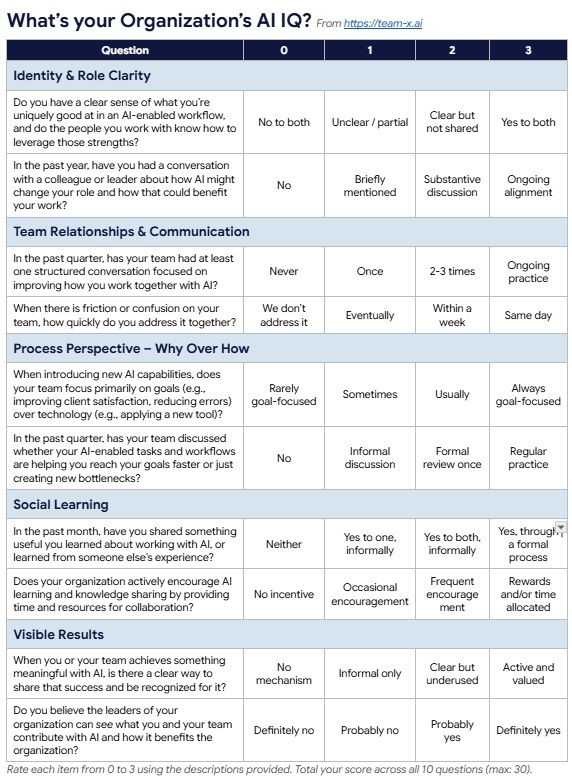
Self-renewingHow Maturity Is Assessed
5 Pillars · 10 Questions · 0–3 Points Each
Key Transitions
Moving Up the Ladder
Each transition requires a specific, deliberate shift — skipping levels is rare.
- Level 1 → Level 2: Establish any regular practice, even a small one, across the five pillars.
- Level 2 → Level 3: Make those practices consistent and habitual, not just occasional.
- Level 3 → Level 4: Commit to meaningful measurement so outcomes can be quantified.
- Level 4 → Level 5: Create self-renewing feedback loops that keep improving without prompting.